Voice AI vs Traditional IVR: Why Make the Switch?
Discover the key differences between modern voice AI and traditional IVR systems, and why businesses are making the switch.
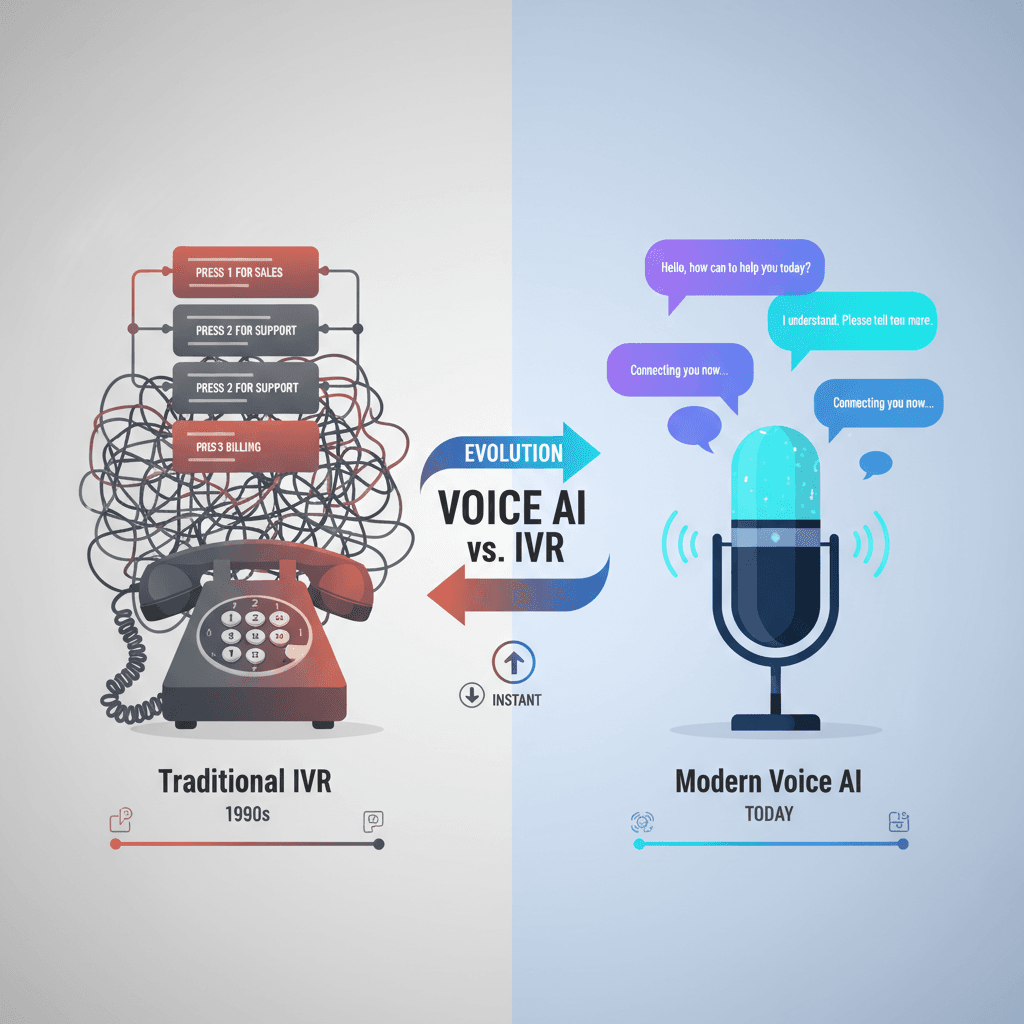
Voice AI vs Traditional IVR: Why Make the Switch?
Traditional Interactive Voice Response (IVR) systems have been the standard for automated phone systems for decades. However, modern voice AI technology offers a dramatically better experience for both customers and businesses. Here's why making the switch makes sense.
The Problem with Traditional IVR
Frustrating User Experience
Traditional IVR systems force customers to navigate through menus:
"Press 1 for sales, press 2 for support, press 3 for billing..."
This menu-driven approach is:
- Time-consuming: Customers must listen to all options
- Frustrating: Easy to get lost in nested menus
- Rigid: Can't handle questions that don't fit predefined options
- Impersonal: Feels robotic and unhelpful
High Abandonment Rates
Studies show that 50-70% of callers abandon IVR systems before reaching a human agent, often because they can't find the right option or get frustrated with the navigation.
Limited Capabilities
Traditional IVR can only:
- Route calls based on keypad input
- Provide basic information from a database
- Transfer to human agents
They cannot:
- Understand natural language
- Handle complex queries
- Learn from interactions
- Provide personalized responses
How Voice AI is Different
Natural Conversations
Voice AI agents can have natural, conversational interactions:
Customer: "I need to check on my order from last week"
Voice AI: "I'd be happy to help you check your order. Can you provide your order number or the email address you used?"
No menus, no button pressing—just natural conversation.
Context Understanding
Voice AI understands context and can handle follow-up questions:
Customer: "What's my account balance?"
Voice AI: "Your current balance is $1,234.56."
Customer: "When was my last payment?"
Voice AI: "Your last payment of $500 was processed on January 5th."
Intelligent Routing
Voice AI can understand the customer's intent and route them appropriately, even if they don't use exact keywords.
Continuous Learning
Modern voice AI systems learn from every interaction, improving their responses over time.
Key Differences at a Glance
| Feature | Traditional IVR | Voice AI | |---------|----------------|----------| | Interaction Style | Menu navigation | Natural conversation | | Language Understanding | None | Advanced NLP | | Context Awareness | None | Full context | | Personalization | Limited | Highly personalized | | Learning Capability | None | Continuous learning | | Customer Satisfaction | Low | High | | Abandonment Rate | 50-70% | < 10% |
Benefits of Switching to Voice AI
1. Improved Customer Satisfaction
Customers prefer natural conversations over menu navigation. Voice AI provides a more human-like experience that customers actually enjoy.
2. Reduced Call Abandonment
With natural conversations and better routing, call abandonment rates drop significantly—often below 10% compared to 50-70% with traditional IVR.
3. Faster Resolution
Voice AI can understand customer intent immediately, eliminating the need to navigate menus. This reduces average handling time.
4. Better Data Collection
Voice AI can extract information naturally during conversation, providing better data for analytics and customer insights.
5. Cost Savings
While both systems reduce the need for human agents, voice AI does it more effectively by handling a wider range of queries and reducing escalations.
Real-World Impact
Case Study: Financial Services
A major bank replaced their traditional IVR with voice AI and saw:
- 60% reduction in call abandonment
- 40% reduction in average handling time
- 25% increase in customer satisfaction scores
- 30% reduction in call center costs
Case Study: Healthcare
A healthcare provider implemented voice AI for appointment scheduling:
- 50% reduction in no-show rates
- 80% of appointments now scheduled automatically
- 15 hours/week saved for administrative staff
Making the Switch
Migration Strategy
- Start with a pilot: Test voice AI with a specific use case
- Run in parallel: Keep IVR running while testing voice AI
- Gather feedback: Monitor customer satisfaction and resolution rates
- Gradual rollout: Expand to more use cases as you see success
- Full migration: Replace IVR once voice AI proves effective
What to Look For
When choosing a voice AI platform to replace your IVR:
- Low latency: < 500ms response time for natural conversations
- Natural voices: Human-like speech that doesn't sound robotic
- Easy integration: Works with your existing phone system
- Analytics: Detailed insights into call performance
- Compliance: Meets industry regulations (HIPAA, PCI-DSS, etc.)
Conclusion
Traditional IVR systems served their purpose, but voice AI represents the next evolution in customer communication. With natural conversations, better understanding, and improved customer satisfaction, voice AI is the clear choice for modern businesses.
The question isn't whether to switch—it's when. And the answer is: the sooner, the better.
Ready to replace your IVR with voice AI? Contact DuetDial to learn how we can help you make the switch.